AUGUST 30, 2019: The Secretary of the Interior today signed Order Number 3376 that adopts the e-bike industry’s class structure and pushes land management agencies to open their non-motorized trails to this form of motorized recreation. The Order sets the path for agencies like the National Park Service and Bureau of Land Management to allow all 3 classes of e-Bikes on trails that are currently designated for mountain bike use.
Fortunately, e-Bikes won’t be instantly added to trails on DOI lands. Each agency will first have to promulgate rules via the formal rule-making process, which includes public notice and opportunities for public comment. But the new policy to allow Class 1, 2 and 3 bikes on trails will be baked into the proposed rule changes.
E-bike designations (Class 1, 2 and 3) were written by a trade organization to do three things: (1) open previously non-motorized trails to motorized vehicles, (2) evade enforcement, and (3) sell more e-bikes. This class definition is being adopted by state and local legislators who don’t understand that opening a non-motorized trail to any class of e-bike, virtually opens the trail to all e-bikes. Here’s why.
THE CLASS DISTINCTION
Class-1 and Class-2 electric bicycles have less than 750 watts and cease to provide power when the bike exceeds 20 miles per hour. The only difference is that a Class-1 electric bike provides power only when the rider is pedaling while a Class-2 electric bike does not require any pedaling to dole out its power. That is done with a twist grip throttle or thumb push throttle. The Class-3 electric motorized bike cuts its power off when the bike reaches 28 miles per hour no matter how you are applying the power.
A TRADE ORGANIZATION DEVELOPED THIS CLASS STRUCTURE
E-bike trade organizations drafted the model legislation that adopts the class structure. Larry Pizzi, Vice President of the Bicycle Products Suppliers Association (BPSA) and chairman of the association’s eBike committee recently committed that, “2019 is going to be a watershed year in moving our 3-class e-bike legislation, nationally. Thanks to the contributing members of the industry for your support in funding this work and to Morgan Lommele and the team at People for Bikes for your dedication, now in our 5th year.”
Once the classes were defined, the trade organization made sure identifying the class of an e-bike was difficult for consumers and next to impossible for a land management agency when the bike is being motored along on a natural-surface trail or bike path.
PUT ON YOUR READING GLASSES
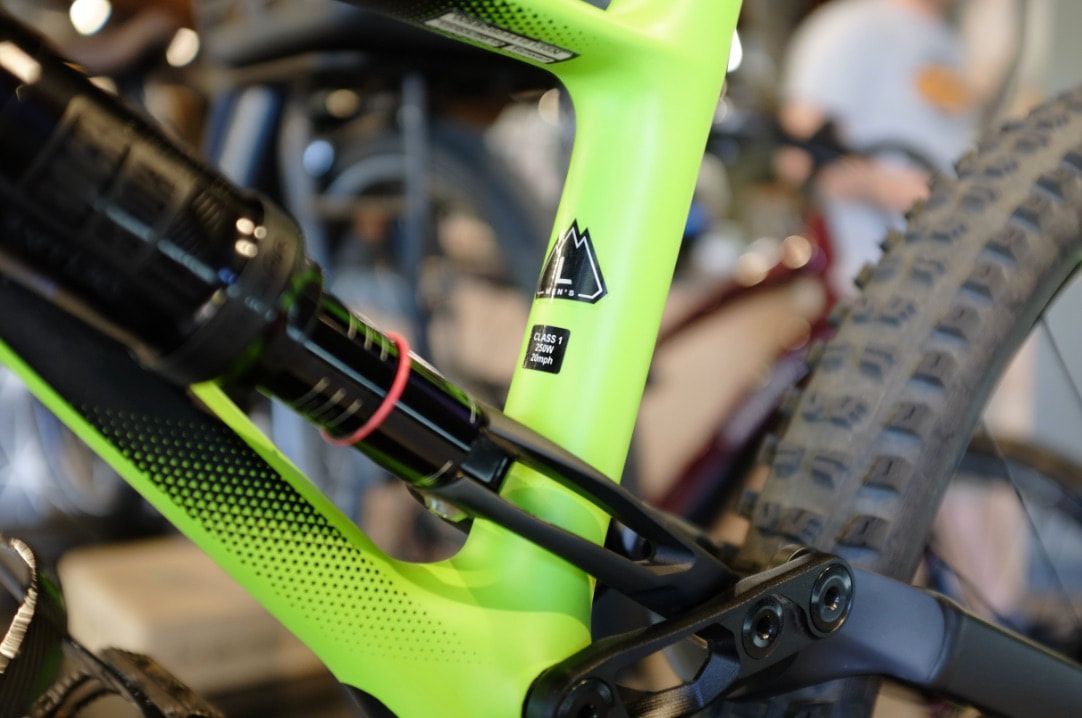
The legislation requires that “manufacturers and distributors of electric bicycles shall apply a label that is permanently affixed, in a prominent location, to each electric bicycle. The label shall contain the classification number, top assisted speed, and motor wattage of the electric bicycle, and shall be printed in Arial font in at least 9-point type.”
The text you are reading right now is 12-point type. But before you can read the tiny 9-point type, you have to find it. Good luck. Visit an e-bike retailer and try to find the label on a few different brands (or on different models from the same brand). Don’t feel bad if you can’t find the label. Retail sales staff had trouble finding them or couldn’t find them for me on some models. Clicking on the above photo will enlarge it so you can read the class sticker.
“Permanently affixed” turns out to be a sticker* and “prominent location” seems to be at the bottom of the seat tube* (an area tough to view if a rider is on the bike). The bike’s brand, model name and frame size are easy to find and read but this info is in larger type and positioned in what is truly a prominent location (like the bike’s head tube, top tube or chainstay).
DIY E-BIKES
States that adopt the model legislation overlook a large source of electric-motorized bicycles. Your garage! Kits are readily available from eBay and Amazon that convert the bicycle in your garage into an e-bike. Manufacturers like Bafang sell their kits direct to consumers. These kits can produce power way above the “legal” 750-watt limit and since the legislation is worded for “manufacturers and distributors of electric bicycles,” these kit sellers don’t need to comply to a class designation sticker.
CONSUMER DIRECT
Consumers can buy directly from a manufacturer and assemble an e-bike themselves. These bikes, sometimes imported directly from a foreign country to the consumer’s home, will not have the designation sticker and it is not hard to find models that exceed even the Class-3 definition.
E-BIKES THAT ARE BOTH
Samson Electric Bikes offer an attractive range of electric-motorized beach cruisers and mountain bikes. While not as technically sophisticated as a $10,000 super e-bike, they offer a feature that allows the bike to be ridden as a Class-1 or a Class- 2 e-bike. The rider simply programs the bike. Does that make it illegal to operate on trails that only permit Class-1 e-bikes because it could be ridden as a Class-2 bike? Or does the rider simply switch to Class 1 when they see a ranger?
HOT RODDING E-BIKES
E-bikes can be modified to exceed the limits set by the model legislation. That means the Class-1 e-bike you purchased can be fitted with an internal component that is undetectable. The bike will still have a Class-1 sticker on it (if the operator hasn’t removed it) although it could greatly exceed the speed and power limits. These modifications would not be visible to a ranger.
MANUFACTURERS ARE ALREADY GAMING THE SYSTEM
Luna e-bikes implies that their customers can ride their Class-3 bikes undetected on trails and Suru shows how a motorcycle-like bicycle is legally considered an e-bike under the model legislation.
LIMITING WATTS DOESN’T LIMIT POWER
The website ebikeschool.com explains that using wattage as the limit of an e-bike’s power is inaccurate and misleading. In their article, “The Myth of E-Bike Wattage” they explain that “limiting the wattage of e-bike motors doesn’t necessarily limit how powerful they can be. Even though a motor is marked as 250 watts (and even if it may actually be a true 250-watt motor), anyone could connect it to a 48V battery and run 20 amps through the motor to achieve 1,000 watts of power.”
OPENING OUR TRAILS TO MOTORIZED RECREATION
The belief that a land management agency can restrict their trails to only Class-1 e-bikes is a myth. Unsuspecting land managers who open their trails to Class-1 e-bikes are essentially opening their trails to all electric-motorized bicycles (including all bicycles converted with electric-motorized kits).
E-bikes are motorized vehicles and a developing technology that is generally inconsistent with a park experience. These motorized vehicles should be welcomed and encouraged on trails designated for motorized recreational activities. They need to be restricted from non-motorized, natural-surface trails.
Optibike claims their e-bike, that is sold consumer direct, has a “top speed of 36 miles per hour and hill climbing ability that is unmatched in the e-bike world.”
Can any park ranger identify the class of this bike? Probably not.
Fortunately, e-Bikes won’t be instantly added to trails on DOI lands. Each agency will first have to promulgate rules via the formal rule-making process, which includes public notice and opportunities for public comment. But the new policy to allow Class 1, 2 and 3 bikes on trails will be baked into the proposed rule changes.
E-bike designations (Class 1, 2 and 3) were written by a trade organization to do three things: (1) open previously non-motorized trails to motorized vehicles, (2) evade enforcement, and (3) sell more e-bikes. This class definition is being adopted by state and local legislators who don’t understand that opening a non-motorized trail to any class of e-bike, virtually opens the trail to all e-bikes. Here’s why.
THE CLASS DISTINCTION
Class-1 and Class-2 electric bicycles have less than 750 watts and cease to provide power when the bike exceeds 20 miles per hour. The only difference is that a Class-1 electric bike provides power only when the rider is pedaling while a Class-2 electric bike does not require any pedaling to dole out its power. That is done with a twist grip throttle or thumb push throttle. The Class-3 electric motorized bike cuts its power off when the bike reaches 28 miles per hour no matter how you are applying the power.
A TRADE ORGANIZATION DEVELOPED THIS CLASS STRUCTURE
E-bike trade organizations drafted the model legislation that adopts the class structure. Larry Pizzi, Vice President of the Bicycle Products Suppliers Association (BPSA) and chairman of the association’s eBike committee recently committed that, “2019 is going to be a watershed year in moving our 3-class e-bike legislation, nationally. Thanks to the contributing members of the industry for your support in funding this work and to Morgan Lommele and the team at People for Bikes for your dedication, now in our 5th year.”
Once the classes were defined, the trade organization made sure identifying the class of an e-bike was difficult for consumers and next to impossible for a land management agency when the bike is being motored along on a natural-surface trail or bike path.
PUT ON YOUR READING GLASSES
The legislation requires that “manufacturers and distributors of electric bicycles shall apply a label that is permanently affixed, in a prominent location, to each electric bicycle. The label shall contain the classification number, top assisted speed, and motor wattage of the electric bicycle, and shall be printed in Arial font in at least 9-point type.”
The text you are reading right now is 12-point type. But before you can read the tiny 9-point type, you have to find it. Good luck. Visit an e-bike retailer and try to find the label on a few different brands (or on different models from the same brand). Don’t feel bad if you can’t find the label. Retail sales staff had trouble finding them or couldn’t find them for me on some models. Clicking on the above photo will enlarge it so you can read the class sticker.
“Permanently affixed” turns out to be a sticker* and “prominent location” seems to be at the bottom of the seat tube* (an area tough to view if a rider is on the bike). The bike’s brand, model name and frame size are easy to find and read but this info is in larger type and positioned in what is truly a prominent location (like the bike’s head tube, top tube or chainstay).
DIY E-BIKES
States that adopt the model legislation overlook a large source of electric-motorized bicycles. Your garage! Kits are readily available from eBay and Amazon that convert the bicycle in your garage into an e-bike. Manufacturers like Bafang sell their kits direct to consumers. These kits can produce power way above the “legal” 750-watt limit and since the legislation is worded for “manufacturers and distributors of electric bicycles,” these kit sellers don’t need to comply to a class designation sticker.
CONSUMER DIRECT
Consumers can buy directly from a manufacturer and assemble an e-bike themselves. These bikes, sometimes imported directly from a foreign country to the consumer’s home, will not have the designation sticker and it is not hard to find models that exceed even the Class-3 definition.
E-BIKES THAT ARE BOTH
Samson Electric Bikes offer an attractive range of electric-motorized beach cruisers and mountain bikes. While not as technically sophisticated as a $10,000 super e-bike, they offer a feature that allows the bike to be ridden as a Class-1 or a Class- 2 e-bike. The rider simply programs the bike. Does that make it illegal to operate on trails that only permit Class-1 e-bikes because it could be ridden as a Class-2 bike? Or does the rider simply switch to Class 1 when they see a ranger?
HOT RODDING E-BIKES
E-bikes can be modified to exceed the limits set by the model legislation. That means the Class-1 e-bike you purchased can be fitted with an internal component that is undetectable. The bike will still have a Class-1 sticker on it (if the operator hasn’t removed it) although it could greatly exceed the speed and power limits. These modifications would not be visible to a ranger.
MANUFACTURERS ARE ALREADY GAMING THE SYSTEM
Luna e-bikes implies that their customers can ride their Class-3 bikes undetected on trails and Suru shows how a motorcycle-like bicycle is legally considered an e-bike under the model legislation.
LIMITING WATTS DOESN’T LIMIT POWER
The website ebikeschool.com explains that using wattage as the limit of an e-bike’s power is inaccurate and misleading. In their article, “The Myth of E-Bike Wattage” they explain that “limiting the wattage of e-bike motors doesn’t necessarily limit how powerful they can be. Even though a motor is marked as 250 watts (and even if it may actually be a true 250-watt motor), anyone could connect it to a 48V battery and run 20 amps through the motor to achieve 1,000 watts of power.”
OPENING OUR TRAILS TO MOTORIZED RECREATION
The belief that a land management agency can restrict their trails to only Class-1 e-bikes is a myth. Unsuspecting land managers who open their trails to Class-1 e-bikes are essentially opening their trails to all electric-motorized bicycles (including all bicycles converted with electric-motorized kits).
E-bikes are motorized vehicles and a developing technology that is generally inconsistent with a park experience. These motorized vehicles should be welcomed and encouraged on trails designated for motorized recreational activities. They need to be restricted from non-motorized, natural-surface trails.
Optibike claims their e-bike, that is sold consumer direct, has a “top speed of 36 miles per hour and hill climbing ability that is unmatched in the e-bike world.”
Can any park ranger identify the class of this bike? Probably not.
 | The number 5 on the left is approximately 9-point type. The number 5 on the right is approximately the size used on a motorcycle license plate. |
About the author: Jim “Jimmy Mac” McIlvain was Editor of Mountain Bike Action Magazine and Road Bike Action Magazine and a contributing editor of Electric Bike Action Magazine. He has been used as a resource by land management agencies in developing e-bike and mountain bike policy. He welcomes feedback or questions from land management agencies, retailers and riders who deal with e-bike issues. The Jimmy Mac On Two Wheels website is self-funded.
*Specialized, Trek, Cannondale, Haibike, Samson and Pedego retailers were visited for this story. Only Pedego displayed class identification that was easy to read and far larger than what is required by law. All labels were adhesive stickers.
CLICK HERE to see the original article on JimmyMac on Two Wheels.com
 RSS Feed